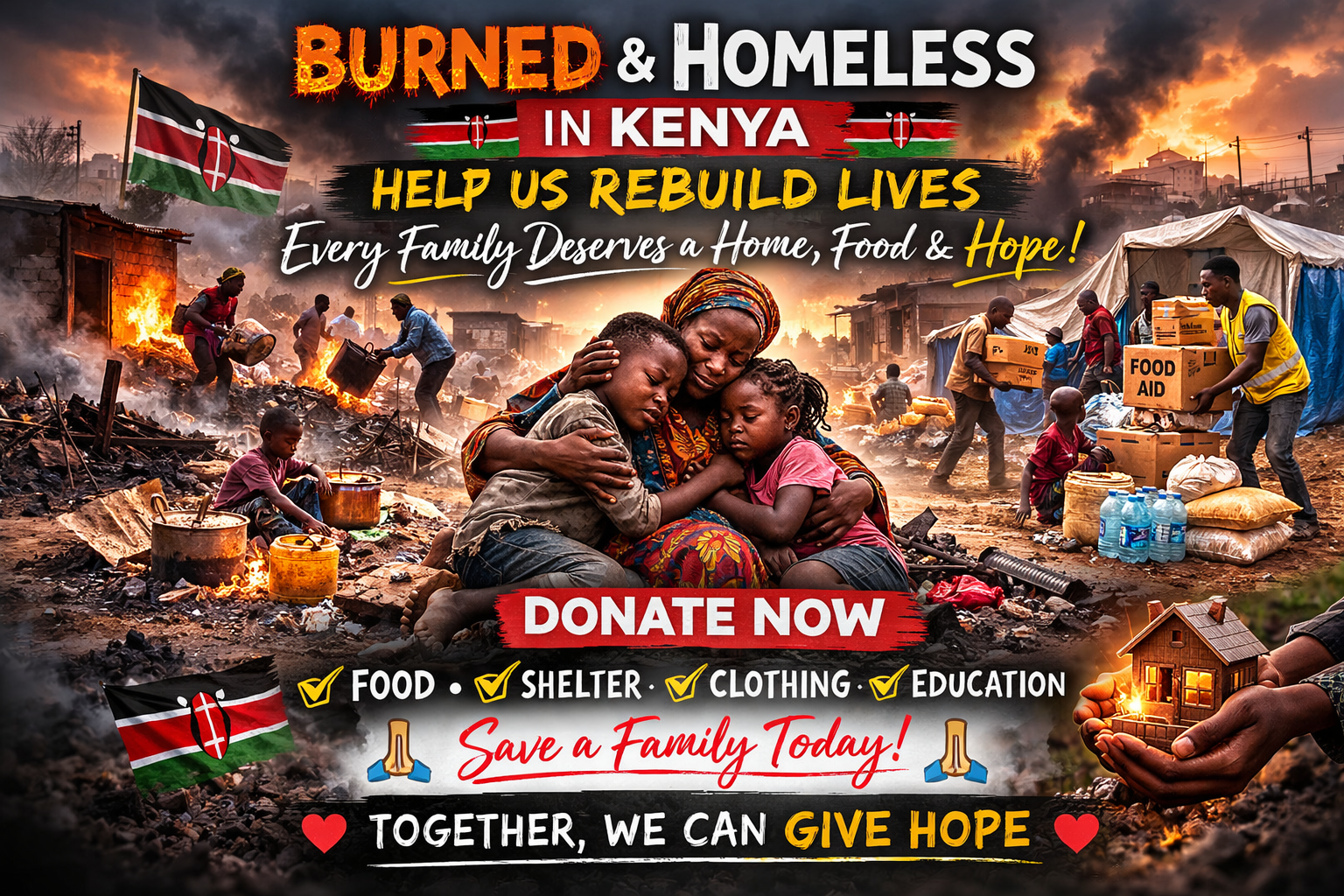
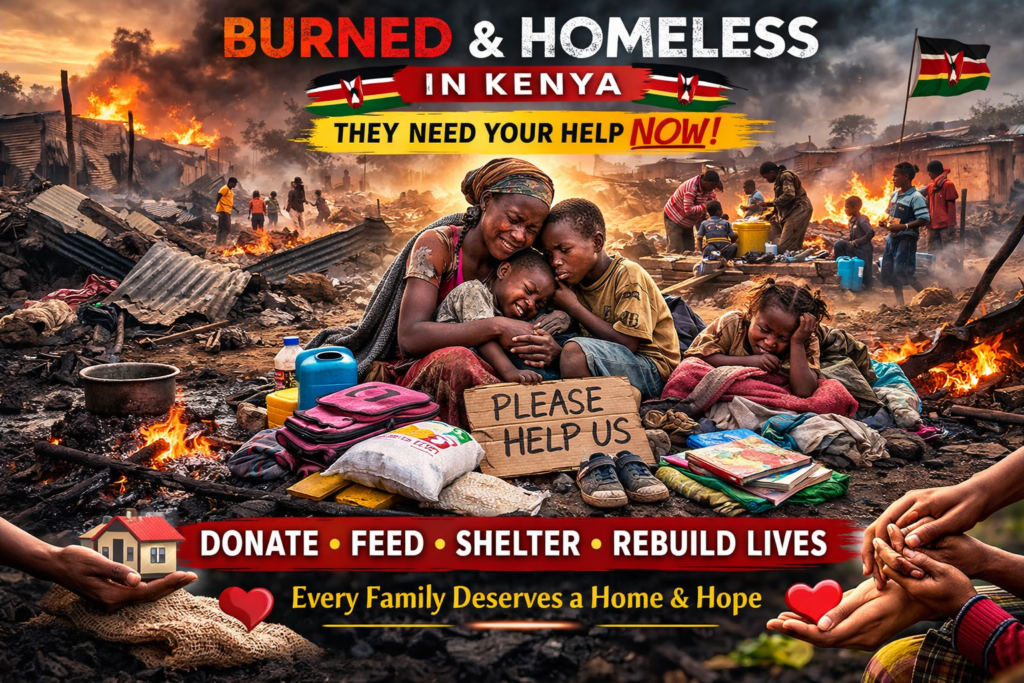
In many parts of Kenya, a single fire can destroy everything a family owns in less than an hour. Homes built from iron sheets, timber, and recycled materials can go up in flames within minutes. When that happens, families are not just left without shelter — they are left without clothes, food, documents, school supplies, and hope.
Behind every burned home is a real story: a mother holding her children in the dark after a midnight fire, a father staring at ashes where his life savings once stood, children missing school because their uniforms and books were reduced to smoke.
This is not rare. It is happening far too often.
The Reality of Fires and Homelessness in Kenya
Urban informal settlements in cities like Nairobi, Mombasa, and Kisumu frequently experience devastating fires. Many of these communities are densely populated, with:
Narrow pathways that block fire engines
Illegal electricity connections
Open-flame cooking methods
Closely packed wooden and iron-sheet structures
When one house catches fire, dozens — sometimes hundreds — burn down.
According to humanitarian reports over the years, thousands of families are displaced annually due to fires and floods across Kenya. Informal settlements such as Kibera and Mathare have repeatedly suffered major fire outbreaks that leave entire blocks destroyed.
When homes burn:
Families sleep outside in the cold
Children drop out of school temporarily
Identification documents are lost
Small businesses are wiped out
Food insecurity increases immediately
And for families already living day-to-day, recovery feels impossible.
Why Burned Families Become Homeless Overnight
Most low-income families in Kenya do not have insurance. They do not have savings accounts to fall back on. Their homes often double as:
Grocery kiosks
Small tailoring shops
Food stalls
Repair workshops
When the structure burns, income disappears instantly.
Imagine earning just enough to feed your children today — and by midnight, everything is gone. No bed. No utensils. No school uniforms. No mattress. Nothing.
Homelessness in Kenya is not always visible in the way people expect. Many families:
Crowd into relatives’ one-room homes
Sleep in churches or schools temporarily
Stay in open fields
Live under plastic sheets
But this is not stability. It is survival.
The Emotional and Psychological Trauma
Losing a home to fire is not just physical destruction — it is emotional devastation.
Children experience fear, nightmares, and anxiety. Parents carry guilt for not being able to protect their families. The stress can lead to depression and hopelessness.
For mothers especially, the pain of not being able to provide food or shelter for their children after a fire is overwhelming. Fathers often feel defeated and ashamed.
This trauma does not disappear when donations stop. Recovery takes time, support, and community.
What Burned and Homeless Families Urgently Need
When a family loses everything in a fire in Kenya, immediate needs include:
1. Emergency Shelter
2. Food and Clean Water
3. Clothing and Hygiene Supplies
Clothes for adults and children
Sanitary pads for women and girls
Soap, toothpaste, diapers
4. School Support
Uniforms
Shoes
Books and stationery
5. Rebuilding Materials
Iron sheets
Timber
Nails and tools
Without these, families remain stuck in a cycle of instability.
The Bigger Problem: Poverty and Vulnerability
Fires are often a symptom of deeper issues:
Poverty
Overcrowding
Unsafe infrastructure
Lack of formal housing
In informal settlements, many families rely on unsafe power connections because legal connections are unaffordable. Cooking is often done using charcoal or kerosene inside small spaces. One accident can destroy an entire community block.
Helping burned families is not just about relief — it is about restoring dignity and stability.
Why They Need Help Now

When disaster strikes in wealthy neighborhoods, insurance companies step in. When disaster strikes in Kenya’s informal settlements, survival depends on community and donors.
Without support:
Children miss weeks or months of school
Malnutrition increases
Families fall deeper into debt
Exploitation risks rise, especially for women and girls
Quick support prevents long-term damage.
A small donation can:
Buy blankets for a family of five
Provide food for a week
Help replace school uniforms
Purchase iron sheets to rebuild a home
This is not charity. This is giving someone a second chance.
How You Can Make a Real Difference
If you are reading this, you are in a position to help.
You can:
Donate to verified relief campaigns
Support local Kenyan community organizations
Fundraise for rebuilding efforts
Share awareness about fire victims and homelessness in Kenya
Every contribution — no matter how small — creates impact.
A Final Word
Imagine standing where your home once stood, surrounded by ashes. Imagine holding your child who asks, “Where will we sleep tonight?”
For many families in Kenya, this is not imagination. It is reality.
They are not lazy. They are not irresponsible. They are vulnerable — and one disaster pushed them into homelessness.
They need help. Not next month. Not someday. Now.
If you care about humanity, if you believe every child deserves a safe place to sleep, then step forward. Support burned and homeless families in Kenya. Restore hope. Rebuild homes. Protect futures.
Because no family should have to sleep in ashes.