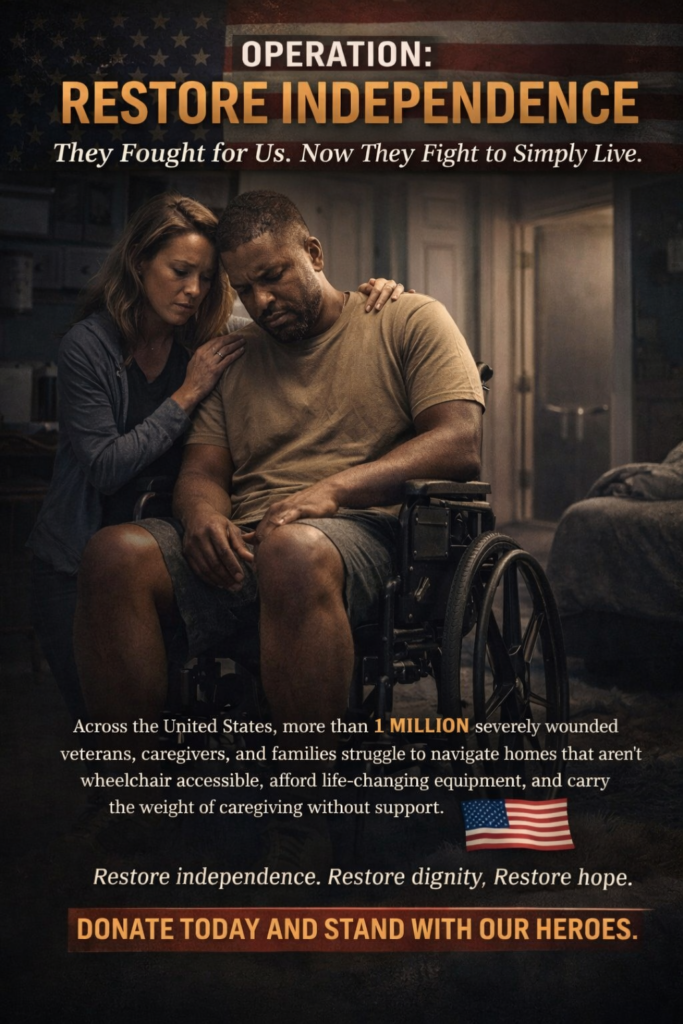
🇺🇸 Operation Restore Independence: The Hidden Battle America’s Wounded Veterans Need HELP Every Day
He once carried 70 pounds of gear across unforgiving terrain.
Today, he struggles to carry himself from his bed to the bathroom.
This is the reality for thousands of wounded veterans across the United States.
When Americans think about war, they picture the battlefield — the uniforms, the courage, the sacrifice. What most don’t see is the second battlefield that begins when a service member comes home with life-altering injuries.
For many veterans, the war doesn’t end. It just changes.
And it happens behind closed doors.
The Deep Reality Most Americans Never See
More than one million veterans in the United States live with service-connected disabilities. These include traumatic brain injuries (TBI), spinal cord injuries, amputations, severe burns, PTSD, and chronic pain conditions.
But here’s what statistics don’t show:
- A wheelchair that doesn’t fit through the front door.
- A shower that can’t be used safely.
- A caregiver spouse who hasn’t slept through the night in years.
- A family drowning in medical debt.
- A veteran who feels like a burden instead of a hero.
These are not rare situations.
They are common.
And they are devastating.
The Financial Burden No One Prepares Them For
While some benefits exist, they often fall short of covering real-life needs.
Adaptive home renovations can cost $20,000 to $100,000 or more depending on injury severity.
Wheelchair-accessible vans can exceed $60,000.
Specialized prosthetics and mobility equipment require ongoing upgrades and maintenance.
Long-term rehabilitation and mental health care can stretch on for decades.
Caregivers — often spouses or parents — frequently leave their jobs to provide full-time support. That means lost income on top of mounting expenses.
The result?
Financial strain. Emotional exhaustion. Isolation.
Many families burn through savings within just a few years of returning home.
The Emotional Toll: The Pain You Can’t See
Physical wounds are visible.
Emotional wounds are not.
PTSD, depression, survivor’s guilt, and anxiety affect countless veterans. According to federal data, thousands of veterans die by suicide each year. Many struggle silently, believing they should “be stronger.”
Imagine surviving combat — only to feel defeated by daily life at home.
Imagine once being the protector — and now needing help to get dressed.
That loss of independence cuts deeper than most people understand.
Independence is dignity.
And when dignity is stripped away, hope begins to fade.
The Caregivers: America’s Silent Heroes
Behind many wounded veterans stands a caregiver who never enlisted — but now serves every day.
Spouses help with bathing, dressing, medications, appointments, mobility transfers, and emotional support.
Parents step back into full-time caregiving roles for adult children.
Children grow up faster than they should.
Caregiver burnout is real. Many experience depression, chronic stress, and financial insecurity.
Yet they continue — out of love.
But love alone doesn’t pay for wheelchair ramps, therapy sessions, or adaptive technology.
Housing: The Crisis Hiding in Plain Sight

One of the greatest challenges wounded veterans face is housing.
Many homes simply are not built for accessibility. Narrow hallways. Stairs. High countertops. Standard bathtubs.
For someone paralyzed or using prosthetics, these obstacles turn everyday life into a series of barriers.
Without modifications, veterans risk falls, injuries, and hospitalizations.
Adaptive housing isn’t a luxury.
It’s survival.
Installing ramps, widening doorways, lowering counters, creating roll-in showers — these changes restore something priceless: freedom inside their own home.
Why Community Support Matters
Organizations across the country have shown that when communities rally behind veterans, lives change.
Homes are rebuilt.
Mortgages are eliminated.
Families breathe again.
But the need still outweighs the resources.
There are veterans right now on waiting lists for assistance.
There are families choosing between therapy appointments and utility bills.
There are caregivers quietly breaking down at night after holding it together all day.
This is not a distant problem.
It is happening in cities and towns across America.
Restoring Independence Changes Everything
When you help restore independence, you do more than fund a project.
You change the trajectory of a life.
- A ramp allows a veteran to leave the house without assistance.
- A specialized wheelchair restores mobility.
- Caregiver support prevents burnout and family collapse.
- Rehabilitation programs rebuild confidence and purpose.
- Reintegration programs help veterans return to meaningful work.
Small changes create massive impact.
Independence leads to dignity.
Dignity leads to hope.
Hope leads to healing.
The Hard Truth
Freedom was paid for in sacrifice.
Many veterans sacrificed their mobility.
Some sacrificed their mental health.
Some sacrificed their ability to work.
Some sacrificed relationships.
And now they are asking for something simple:
A chance to live with independence.
Not charity.
Not pity.
Just the tools to function safely and with dignity.
Why Your Donation Matters Right Now
Every dollar makes a tangible difference.
$50 can help provide adaptive equipment.
$250 can contribute toward home modifications.
$1,000 can help fund rehabilitation and caregiver support services.
But beyond the amount — your donation sends a message:
“You are not forgotten.”
And that message matters more than most people realize.
Isolation is one of the greatest threats wounded veterans face. Community support breaks that isolation.
If We Don’t Act
If we turn away, the consequences are real.
More financial collapses.
More caregiver burnout.
More untreated trauma.
More veterans feeling abandoned after serving their country.
That cannot be the legacy we leave.
America prides itself on honoring its heroes. But honor requires action.
Operation Restore Independence
This mission is simple:
Restore independence.
Restore dignity.
Restore hope.
By supporting wounded veterans and their families with adaptive housing, mobility equipment, caregiver assistance, and rehabilitation services, we help close the gap between sacrifice and stability.
This is not politics.
This is humanity.
Stand With Them
If you’ve ever stood for the national anthem…
If you’ve ever thanked a veteran for their service…
If you’ve ever believed freedom matters…
Now is the moment to act.
Donate.
Share this mission.
Honor a veteran by helping restore their independence.
Because while freedom isn’t free — support is something we can choose to give.
🇺🇸 Stand with our wounded heroes today.