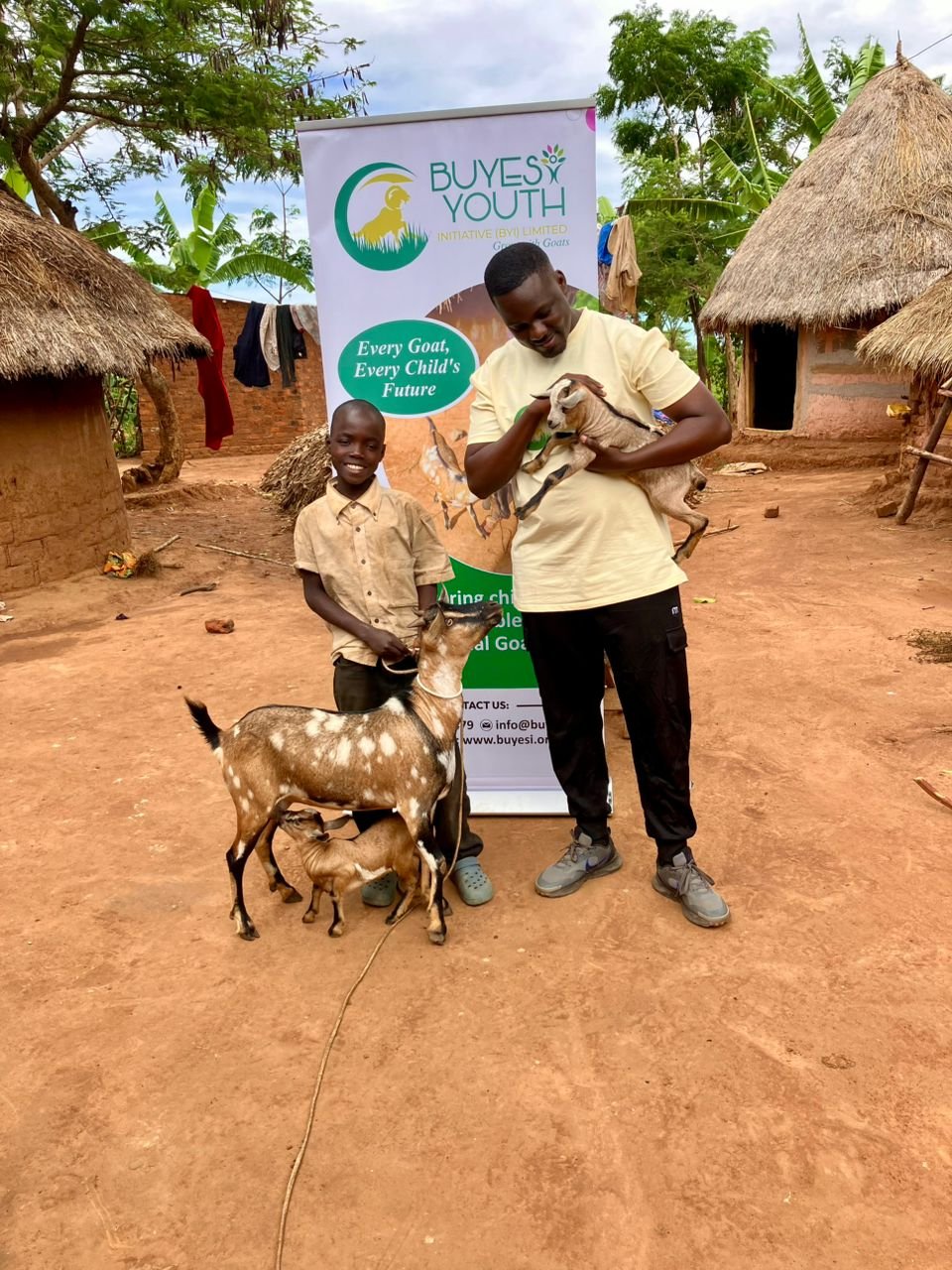
My name is Doughlous Koche, Co-Founder, Buyesi Youth Initiative located in Pallisa District, Eastern Region of Uganda.
With our Slogan, "Grow with Goats", we aim at empowering smallholder goat farmers to achieve economic prosperity, food security and improved livelihoods through sustainable and innovative goat farming practices in Uganda and beyond.
Pallisa District located in the Eastern Region of Uganda, faces significant socio-economic challenges that hinder development and limit the well-being of its population. Poverty levels are alarmingly high, with 48% of residents living below the poverty line, far above the national average of 16.1%, translating to approximately 174,048 individuals enduring extreme financial hardship (Uganda National Household Survey [UNHS], 2023/24). The district’s economic decline, stemming from the marginalization of its once-thriving cotton sector, has left communities vulnerable to structural inequalities, drought, and global economic shocks. Children aged 6–15 are disproportionately affected, facing limited access to education, livelihood skills, and participatory engagement, which perpetuates an intergenerational cycle of poverty (GlobalGiving Report, 2024; Albertine Region Sustainable Development Project, 2025).
Historically, Pallisa’s economy was anchored in cotton production, but output has significantly declined over the past two decades, dropping from 5,000 tons in 2000 to 1,500 tons in 2020, with corresponding economic contributions falling from UGX 200 million to UGX 60 million. Contributing factors include underrepresentation in national agricultural policies, lack of infrastructure for market access, limited investment in modern farming techniques, and external shocks such as climate change and COVID-19 disruptions. The collapse of cotton production has entrenched poverty, constrained household incomes, and restricted families’ ability to provide quality education and opportunities for children (Albertine Region Sustainable Development Project, 2025). Interventions that integrate sustainable agriculture with youth empowerment.
The Every Goat Every Child's Future programme offers a pathway to revitalize local livelihoods. By linking child-centered goat-rearing to education and entrepreneurship, the initiative promotes economic literacy, responsibility, and resilience among youth, while using high-value breeds and digital tracking systems to enhance productivity and accountability (GlobalGiving Report, 2024).
Poverty has also directly impacted education and child development in Pallisa. Despite an increase in schools from 150 in 2017 to 170 in 2021, nearly half of children still lack essential learning materials, uniforms, and transportation, leading households to prioritize survival over schooling (GlobalGiving Report, 2024; Albertine Region Sustainable Development Project, 2025). Beyond academics, poverty contributes to malnutrition, inadequate healthcare, and limited cognitive and social development, particularly among children under five, reinforcing intergenerational deprivation (Local Education & Activities Foundation Report, 2024). The programme addresses these challenges by integrating educational support with goat-rearing entrepreneurship and mindset transformation. Children receive local female goats, mentorship in livestock care and economic literacy, and school facilitation, while the e-animal tracking system ensures monitoring, accountability, and data-driven impact. This integrated approach not only improves child development and household incomes but also fosters sustainable socio-economic transformation in Pallisa District.
Project Approach
Mindset Change & Therapy Model:
The project will implement a cyclical model that integrates goat-rearing with education and entrepreneurship, aiming to instill responsibility, discipline, and long-term economic planning among children. The process works as follows:
Step one (distribution of goats): Each child will receive a local female goat as a starting asset, providing a tangible resource to engage in livestock management and develop a sense of ownership and accountability.
Step two (mentorship and skills training): Children will be mentored on goat care, nutrition, reproduction, and basic financial management. This guidance will equip them with practical skills in animal husbandry and foundational knowledge in small-scale business management.
Step three and four (herd multiplication and upgrading): As the herd grows, the goat offspring is passed onto the next child in the cycle, and when the goats multiply, children will receive high-quality breeds to enhance productivity and income potential. These steps will demonstrate the benefits of investment and long-term planning in agricultural entrepreneurship and household sustainability.
Step five (scaling to commercial farming): Continued herd growth will enable children to transition into small-scale commercial goat farmers, generating sustainable household income and supporting consistent educational opportunities.
Step six (community mindset shift): Through this process, the project will foster a broader community shift toward entrepreneurship and self-reliance, encouraging households to view farming as a viable and profitable enterprise.
Funding Request
Requested amount: The project requests USD 8,000 to scale the initiative from 30 to 100 children, enabling wider access to education and livelihood opportunities across rural communities in Pallisa district.
Procurement of goats: Funds will be used to purchase 100 local female goats, ensuring each child receives a starter animal to learn responsibility, animal husbandry, and small-scale entrepreneurship.
Training and mentorship: Resources will support structured training and mentorship on goat care, nutrition, breeding, business management, and mindset transformation to build practical skills and entrepreneurial thinking.
Veterinary care and feed: The budget will cover veterinary services, vaccinations, and feed supplies to ensure healthy, productive herds, minimizing losses and maximizing income potential for participating children and households.
Educational materials: Children will receive school materials, books, uniforms, and stationery to improve attendance, learning outcomes, and reduce barriers to education while linking academics with practical livelihood skills.
Digital goat-tracking app: Funds will support the development and maintenance of an e-animal tracking system for real-time monitoring of goat health, herd growth, and project impact, enabling data-driven decisions.
Staff coordination and community engagement: The project will allocate resources for staff salaries, field visits, transportation, and continuous community sensitization to ensure smooth implementation, accountability, and sustained participation.
Impact of funding: This investment will allow the project to reach a critical mass of 300 children, creating measurable educational and economic outcomes while fostering a community-wide mindset shift toward entrepreneurship and self-reliance.
Conclusion
The Every Goat Every Child Future Programme is designed to empower children, strengthen households, and nurture future entrepreneurs in Pallisa District. By combining education support, child-centered goat-rearing, and mindset transformation, the project creates a practical and sustainable pathway out of poverty, equipping children and families with skills, income, and confidence for long-term development.
Your support can directly provide goats, educational resources, and mentorship, giving vulnerable children hope and opportunities for a brighter future. Join us in transforming Pallisa, one child and one goat at a time, and be part of a lasting change that benefits families, communities, and the next generation of rural entrepreneurs.
Contact and support through https://www.buyesi.org/contact
Bank details:
Bank Name: Equity Bank Uganda Limited
Account Name: Buyesi Youth Initiative (BYI) Limited
Account Number: 1001203394603
Branch: Pallisa Branch
Swift Code: EQBLUGKA
Thank you, God bless you.
Let's Grow with Goats.