MWITE GENERAL FARM & ECO-RESORT
Comprehensive Business Description and Development Concept
1. Executive Summary
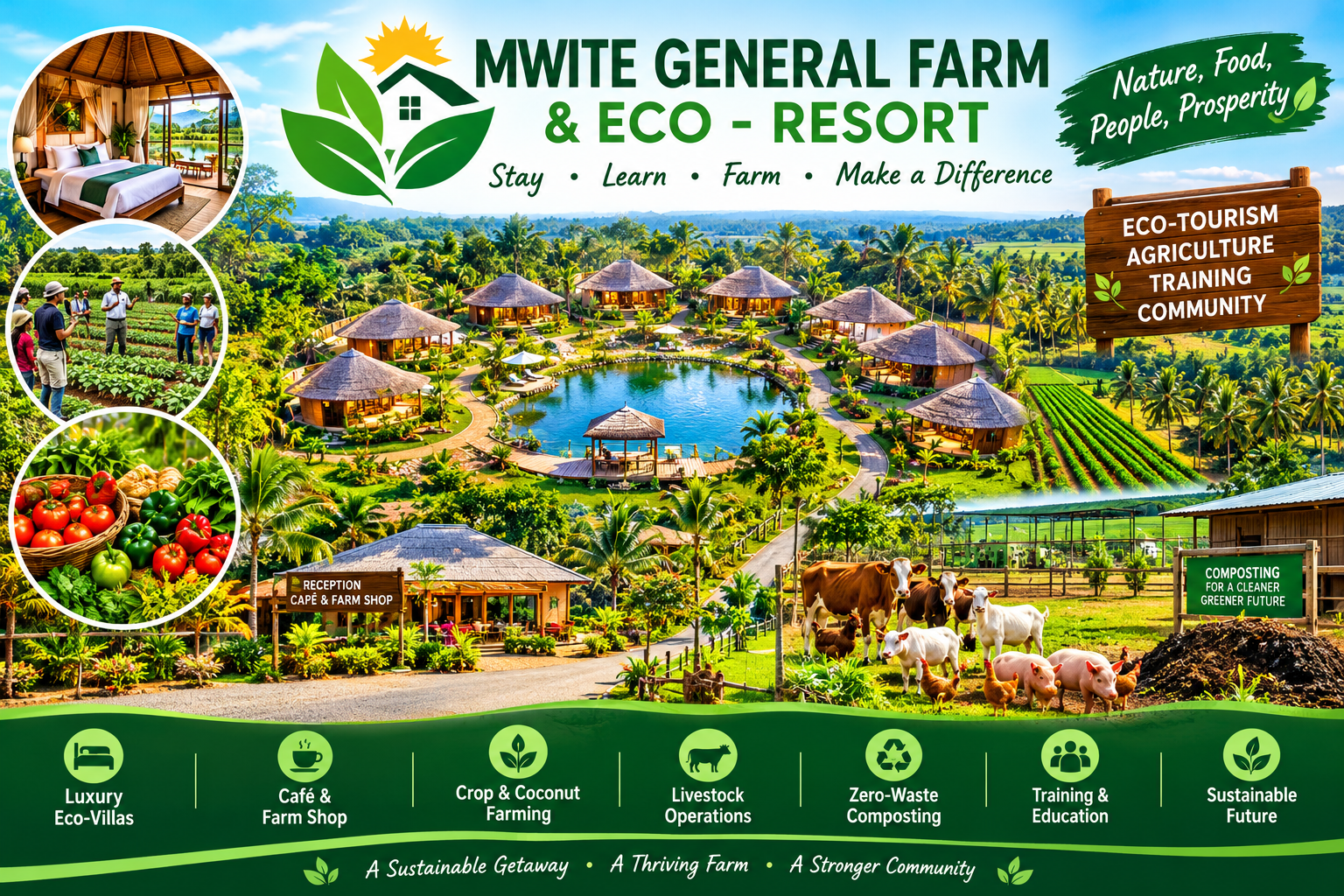
MWITE GENERAL FARM & ECO-RESORT is a proposed integrated eco-tourism, hospitality, and agricultural development designed to bring together leisure, sustainable food production, practical agricultural education, and community empowerment within a carefully planned 15-acre property.
The project aims to create a distinctive destination where visitors can experience the beauty of nature, enjoy comfortable accommodation, explore working farms, learn sustainable farming practices, and participate in meaningful rural experiences. At the same time, the resort will operate as a productive agricultural enterprise, generating income through crop cultivation, livestock production, hospitality services, educational programs, and farm-based retail.
The proposed development will feature ten luxury circular eco-villas arranged around a natural swimming pond, a visitor reception centre, a café and farm shop, cultivated crop fields, coconut groves, bio-secured livestock facilities, and an on-site composting system.
MWITE GENERAL FARM & ECO-RESORT will be developed around the principle that tourism, agriculture, environmental protection, and community development can reinforce one another. Rather than functioning as a conventional resort or an ordinary commercial farm, the business will integrate these activities into one sustainable operating model.
The long-term ambition is to establish MWITE as a recognised eco-tourism and agri-tourism destination that attracts local visitors, international travellers, families, educational institutions, corporate groups, and aspiring farmers.
Business name: MWITE GENERAL FARM & ECO-RESORT
Proposed legal structure: To be determined in accordance with applicable registration, investment, land-use, and business regulations.
Proposed development area: 15 acres.
Primary business sectors: Eco-tourism, hospitality, agriculture, livestock production, agricultural education, and environmental sustainability.
Development vision: To become a leading eco-resort and agri-tourism hub promoting sustainable agriculture, leisure, rural education, and inclusive community growth.
2. Business Description
MWITE GENERAL FARM & ECO-RESORT is envisioned as a multi-purpose rural destination that combines premium hospitality with authentic agricultural experiences and environmentally responsible production.
The business will provide guests with opportunities to relax in a natural setting while discovering how food is grown, livestock is managed, agricultural waste is recycled, and rural enterprises can contribute to sustainable development.
The resort will serve both leisure visitors and individuals seeking practical knowledge about farming, entrepreneurship, environmental conservation, and rural livelihoods.
Its integrated business model will allow the various activities to support one another. The farm will supply fresh produce to the café and farm shop, agricultural activities will provide educational and recreational experiences, and composting will return organic nutrients to the soil. Hospitality and event services will generate additional revenue while creating opportunities for local employment and enterprise.
Vision
To be a leading eco-resort and agri-tourism destination recognised for exceptional hospitality, sustainable agricultural production, practical rural education, environmental stewardship, and positive community impact.
Mission
To deliver high-quality hospitality and authentic farm experiences while developing productive agricultural enterprises, providing practical training opportunities, protecting natural resources, creating local employment, and supporting the long-term prosperity of surrounding communities.
Core values
- Sustainability: Responsible use of land, water, energy, and natural resources.
- Hospitality: Welcoming, safe, comfortable, and memorable experiences for every guest.
- Agricultural excellence: Productive farming practices, responsible livestock care, and continuous improvement.
- Education: Practical learning, knowledge-sharing, and skills development.
- Community partnership: Local employment, supplier relationships, and inclusive opportunities.
- Integrity: Transparent management, responsible financial practices, and compliance with applicable laws.
3. Main Business Activities and Services
MWITE GENERAL FARM & ECO-RESORT will operate through several complementary business divisions.
3.1 Eco-Tourism and Hospitality
The hospitality division will provide comfortable accommodation, leisure facilities, dining, guided experiences, and event services in a natural rural environment.
Luxury eco-villas
The proposed development includes ten circular eco-villas positioned around a central natural swimming pond. The villas will be designed to offer privacy, comfort, attractive views, and a distinctive architectural identity that complements the surrounding landscape.
Each villa will be planned with appropriate sleeping, bathroom, ventilation, lighting, and guest-comfort facilities. Construction materials and building systems will be selected with consideration for durability, local availability, energy efficiency, and environmental impact.
The accommodation offering may include:
- Overnight stays and weekend getaways.
- Family holidays and private retreats.
- Romantic stays and special celebrations.
- Extended accommodation packages.
- Group bookings, subject to available capacity.
The natural swimming pond will serve as a central recreational feature. Its design and operation will incorporate appropriate water-quality management, safe access, guest supervision arrangements, and relevant environmental and public-health requirements.
Visitor reception and hospitality hub
A visitor hub near the western entrance will provide a central point for guest reception, information, bookings, and customer service.
The facility will include:
- A reception and visitor information area.
- A café serving refreshments and locally inspired meals.
- A farm shop offering fresh produce and selected farm products.
- Guest waiting and gathering areas.
- Space for tour coordination and educational activities.
The hub will help visitors understand the resort’s agricultural activities, sustainability practices, and available experiences.
Guided farm tours and guest experiences
Guests will have opportunities to explore selected agricultural areas through guided tours and organised activities.
Possible experiences include:
- Guided crop and coconut grove tours.
- Demonstrations of planting, harvesting, and food production.
- Farm-to-table dining experiences.
- Educational introductions to livestock management.
- Organic composting and soil-improvement demonstrations.
- Seasonal harvest events and family farm activities.
All tours will be organised according to safety, animal welfare, hygiene, and biosecurity requirements. Guest access to livestock production areas will be controlled, with suitable alternatives such as viewing points or supervised demonstrations.
Events and group hospitality
The resort may also host carefully managed activities such as corporate retreats, educational visits, agricultural workshops, community events, and private celebrations.
These activities will provide additional income while making productive use of the resort’s facilities and natural setting.
3.2 Crop Agriculture and Coconut Production
The agricultural division will develop productive crop fields and coconut groves using planned cultivation systems suited to local soil, rainfall, climate, and market conditions.
The proposed crop portfolio includes:
- Cassava.
- Maize.
- Tomatoes.
- Peppers.
- Leafy vegetables.
- Coconut and selected coconut-derived products.
Crop selection, planting schedules, and production volumes will be determined through local agricultural assessments, market research, and seasonal planning.
Crop production strategy
The farm will use organised plots to support efficient cultivation, crop rotation where appropriate, irrigation planning, pest management, harvesting, and recordkeeping.
The agricultural operation will aim to:
- Produce quality crops for local and regional markets.
- Supply selected fresh ingredients to the resort café.
- Provide produce for the farm shop.
- Demonstrate practical and sustainable farming techniques.
- Develop opportunities for processing and value addition as the business grows.
Potential coconut products may include fresh coconuts, coconut water, dried coconut, and other processed products, subject to suitable processing facilities, food-safety compliance, and market demand.
The farm will prioritise soil health, responsible water use, integrated pest management, and appropriate agricultural inputs.
3.3 Bio-Secured Livestock Production
MWITE will establish livestock production areas designed to support animal welfare, operational efficiency, disease prevention, and responsible waste handling.
The proposed livestock units will include cattle, goats, pigs, and poultry.
Each unit will be developed with suitable housing, feeding, watering, drainage, veterinary access, handling facilities, and waste-management systems.
Livestock management priorities
- Maintain appropriate animal housing and stocking densities.
- Provide clean water, balanced feed, and routine animal-health care.
- Establish biosecurity procedures to reduce disease transmission.
- Maintain appropriate separation between livestock operations and guest accommodation.
- Use responsible manure storage and handling practices.
- Keep production and animal-health records.
- Comply with relevant veterinary, animal welfare, and food-safety requirements.
Livestock products may be sold through suitable local markets and approved distribution channels. The specific products, production volumes, and sales arrangements will depend on market opportunities and the operational capacity of each unit.
Because livestock operations carry particular hygiene and disease risks, the business will establish clear procedures for visitors, employees, suppliers, and animal movements.
3.4 Circular Waste Management and Compost Production
A central sustainability feature of MWITE will be the conversion of suitable agricultural and livestock waste into useful organic fertiliser.
The composting facility will be located near the agricultural and livestock zones, with appropriate separation from guest accommodation, food-service operations, water sources, and sensitive areas.
The system will be designed to process suitable crop residues and properly managed animal manure into compost for agricultural use.
Proposed benefits include:
- Reducing the amount of agricultural waste requiring disposal.
- Returning organic matter and nutrients to the soil.
- Improving soil structure and supporting crop productivity.
- Reducing dependence on some externally purchased soil amendments.
- Demonstrating practical circular-economy principles to visitors and trainees.
The composting system will incorporate appropriate controls for odour, runoff, pests, pathogens, and compost maturity. Material will only be applied to crops or sold when it is suitable for the intended use and complies with applicable standards.
As the enterprise develops, surplus compost may become a potential farm-shop product or a supply opportunity for neighbouring farmers.
4. Target Market and Customer Segments
MWITE GENERAL FARM & ECO-RESORT will serve a diverse customer base, reducing dependence on any single source of revenue.
Local residents and families
Local customers will be attracted by recreational activities, family outings, fresh farm produce, café services, special events, and weekend accommodation.
The resort may develop day-visit packages, family farm experiences, seasonal events, and locally priced activities to encourage repeat visits.
International eco-tourists and adventure travellers
International visitors seeking nature-based tourism, authentic rural experiences, and locally rooted hospitality will form another potential customer segment.
The business will develop attractive accommodation and experience packages and pursue relationships with tour operators, travel agencies, tourism organisations, and online booking platforms.
Schools, colleges, and educational institutions
The resort’s agricultural operations and sustainability systems will provide opportunities for educational visits.
Programs may introduce students to crop cultivation, animal care, environmental conservation, soil health, waste recycling, and rural entrepreneurship.
Educational visits will be planned around curriculum relevance, appropriate supervision, group capacity, and visitor safety.
Corporate and institutional groups
Corporate clients, organisations, and institutions may use the resort for retreats, workshops, meetings, team-building activities, and training programs.
The business will explore packages combining accommodation, meals, meeting facilities, guided farm experiences, and outdoor activities.
Aspiring farmers and agricultural entrepreneurs
MWITE will provide practical learning opportunities for individuals seeking to develop agricultural skills or establish farming businesses.
Training may cover crop planning, farm management, livestock care, composting, marketing, financial planning, and sustainable production.
Programs will be designed according to local needs and the expertise available to deliver them.
Local businesses and agricultural buyers
Restaurants, retailers, traders, and other agricultural buyers may purchase suitable farm produce, livestock products, or processed goods.
These relationships will be developed through consistent product quality, reliable supply, appropriate pricing, and clear sales arrangements.
5. Competitive Advantage and Unique Selling Proposition
MWITE GENERAL FARM & ECO-RESORT will distinguish itself by combining accommodation, agriculture, recreation, education, and environmental sustainability within one integrated destination.
Its competitive strengths will include:
An integrated farm-and-resort experience
Visitors will have the opportunity to enjoy hospitality while experiencing an operating agricultural enterprise. This combination offers a different experience from a conventional hotel or a farm focused exclusively on production.
Distinctive eco-villa accommodation
The proposed circular arrangement of ten eco-villas around a central swimming pond will provide a memorable visual identity and a natural focal point for the resort.
Practical agricultural education
The business will offer learning experiences grounded in real agricultural operations, creating opportunities for students, farmers, and aspiring entrepreneurs to develop practical knowledge.
Diversified business activities
Hospitality, crop production, livestock, retail, and training will create several potential income sources. This diversification may help the business manage seasonal demand and changing market conditions, although each division will require its own cost and profitability assessment.
Environmental responsibility
Composting, resource-efficient farming, thoughtful site planning, and responsible hospitality practices will help embed sustainability into daily operations.
Community participation
Local employment, procurement, training, and community partnerships will create opportunities for surrounding communities to participate in and benefit from the development.
6. Business Goals and Three-Year Development Objectives
MWITE GENERAL FARM & ECO-RESORT will pursue a phased development strategy, with priorities determined by financing, construction readiness, market demand, and regulatory approvals.
Year One: Establishment and operational readiness
The first year will focus on developing the project’s foundations.
Key objectives include:
- Finalise the business structure, site assessments, permits, and development plans.
- Complete detailed architectural, engineering, agricultural, and environmental planning.
- Secure appropriate financing and establish project management systems.
- Begin priority infrastructure and facility development.
- Establish initial agricultural production where practical.
- Develop the brand, website, marketing materials, and customer booking systems.
- Prepare operating procedures for hospitality, farm production, livestock, and safety.
The specific facilities opened during the first year will depend on available capital and construction timelines.
Year Two: Launch and market development
The second year will focus on launching operational services and building a stable customer base.
Key objectives include:
- Open completed accommodation and visitor facilities.
- Develop regular café, farm-shop, and guided-tour services.
- Expand crop production and livestock operations according to demand and capacity.
- Introduce structured agricultural training and educational visits.
- Establish partnerships with tour operators, schools, suppliers, and agricultural buyers.
- Monitor customer satisfaction, operating costs, sales, and resource use.
Year Three: Consolidation and sustainable growth
The third year will focus on improving performance, strengthening the brand, and expanding successful activities.
Key objectives include:
- Build recognition as a leading regional eco-tourism and agri-tourism destination.
- Improve occupancy, customer retention, and revenue performance.
- Strengthen the quality and consistency of agricultural production.
- Expand profitable educational and hospitality packages.
- Develop suitable value-added agricultural products.
- Increase local employment, training opportunities, and supplier participation.
- Review sustainability performance and establish measurable improvement targets.
The three-year ambition is to establish a professionally managed, financially viable, and environmentally responsible business with diversified income and a meaningful community contribution.
7. Revenue Model and Commercial Opportunities
MWITE GENERAL FARM & ECO-RESORT will generate revenue through multiple business activities.
Accommodation revenue
Income from overnight stays, weekend packages, group accommodation, and special bookings.
Revenue will depend on the number of operational villas, average occupancy, seasonal demand, pricing, and operating expenses.
Café and farm-shop revenue
The café will generate income from meals, beverages, refreshments, and hospitality services.
The farm shop may sell fresh produce, selected livestock products, coconut products, processed agricultural goods, and other locally sourced items.
Farm-tour and event revenue
Guided tours, seasonal experiences, educational visits, group activities, and private events may be offered at appropriate fees.
Agricultural revenue
Income may come from selling cassava, maize, vegetables, coconuts, livestock, and other suitable agricultural products.
The production and sales plan will be based on crop yields, livestock capacity, market prices, and the costs of inputs, labour, transport, and distribution.
Training and workshop revenue
Agricultural training, practical workshops, and specialised educational programs may generate fees from individuals, institutions, organisations, or sponsored participants.
Additional commercial opportunities
As the business grows, MWITE may explore:
- Processed and packaged agricultural products.
- Coconut-based products.
- Compost and soil-improvement products.
- Corporate retreat packages.
- Memberships or repeat-visitor programs.
- Partnerships with educational and tourism organisations.
All revenue streams will be assessed for feasibility, investment requirements, operating costs, and profitability before expansion.
8. Operations and 15-Acre Site Development Plan
The 15-acre property will be organised into functional zones to create a comfortable visitor environment while supporting efficient farming and livestock management.
The final site layout will be confirmed through professional planning, topographical and soil assessments, drainage design, infrastructure planning, environmental review, and relevant approvals.
Zone One: Eco-villas and central leisure area
Ten proposed circular eco-villas will be arranged around a central natural swimming pond near the heart of the resort.
This zone will prioritise guest comfort, privacy, landscaping, safe pedestrian circulation, and access to appropriate leisure facilities.
The design will consider noise control, water management, emergency access, and the separation of guests from agricultural hazards.
Zone Two: Visitor reception, café, and farm shop
The visitor hub will be positioned near the western entrance to provide convenient access for guests, day visitors, suppliers, and event participants.
The area will accommodate reception, customer service, food and beverage operations, farm retail, and visitor information.
Deliveries, waste handling, and service access will be organised to avoid unnecessary disruption to guest areas.
Zone Three: Livestock production
Livestock units will be situated in the southern portion of the property, subject to site conditions and applicable separation requirements.
The zone will be designed for appropriate animal housing, feed storage, veterinary access, drainage, waste handling, and secure movement of animals and staff.
Guest access will be restricted or carefully supervised according to biosecurity and animal welfare procedures.
Zone Four: Crop fields and coconut groves
The eastern portion of the property is proposed for cultivated crop plots and coconut production.
The agricultural layout will allow practical access for planting, irrigation, harvesting, equipment movement, and produce transport.
Crop selection and field allocation will be refined according to soil suitability, water availability, market opportunities, and production planning.
Zone Five: Composting and resource recovery
The composting facility will be positioned close enough to the agricultural and livestock zones to support efficient collection and processing.
Its design will account for drainage, runoff prevention, odour management, access, and protection of water sources and guest facilities.
Zone Six: Internal roads, pathways, and landscaping
Internal roads and pedestrian paths will connect the major operational areas.
The circulation system will be designed to accommodate guest movement, farm vehicles, deliveries, emergency access, and appropriate separation between different traffic types.
Landscaped buffers, trees, and natural planting will support privacy, visual appeal, erosion management, and a pleasant visitor experience.
Important site-planning consideration: The proposed zones must fit within the 15-acre property alongside roads, drainage, utilities, staff facilities, parking, setbacks, and other necessary infrastructure. A professional site plan will establish whether the proposed facilities and agricultural activities can be accommodated at the intended scale.
9. Marketing and Sales Strategy
MWITE will develop a recognisable brand that communicates nature, comfort, sustainable farming, education, and community impact.
Digital marketing
The business will establish a professional website featuring accommodation, farm experiences, available facilities, booking information, photographs, contact details, and the resort’s sustainability approach.
Social media platforms will be used to share farm activities, guest experiences, agricultural education, seasonal produce, community partnerships, and development milestones.
Online booking systems will help manage reservations, customer enquiries, availability, and payments.
Tourism and travel partnerships
The resort will seek partnerships with relevant tour operators, travel agencies, tourism businesses, and local organisations.
These relationships may support referrals, package development, group bookings, and international visitor outreach.
Community engagement
Community outreach will help introduce the resort to nearby residents and potential partners.
Activities may include launch events, farm open days, agricultural demonstrations, school visits, community workshops, and collaborations with local suppliers.
Educational marketing
MWITE will develop information materials for schools, colleges, agricultural organisations, and training participants.
Programs will highlight practical learning opportunities and the connection between agriculture, environmental sustainability, and entrepreneurship.
Customer retention
The business will encourage repeat visits through seasonal experiences, special offers, family packages, customer feedback, and well-managed guest services.
Marketing performance will be evaluated through enquiries, bookings, occupancy, customer reviews, repeat visits, and sales conversion.
10. Sustainability and Environmental Management
Environmental responsibility will be incorporated into the planning, construction, and day-to-day operation of the resort.
The objective is to reduce unnecessary environmental impacts while maintaining productive agricultural and hospitality activities.
Sustainable land management
The farm will adopt suitable soil-conservation practices, responsible cultivation methods, and appropriate landscaping.
Crop rotation, organic matter management, erosion control, and efficient field planning will be considered according to local conditions.
Water stewardship
Water use will be planned for accommodation, the café, swimming facilities, crops, livestock, and cleaning.
The project will assess suitable water sources, storage, irrigation systems, conservation measures, wastewater treatment, and safe discharge arrangements.
Water quality and availability will be important factors in determining the feasibility and scale of the proposed development.
Renewable and efficient energy
The resort will explore energy-efficient building design, efficient lighting and equipment, and suitable renewable-energy systems.
Potential solar applications will be assessed according to technical feasibility, capital cost, energy demand, and maintenance requirements.
Waste reduction and recycling
The business will prioritise waste prevention, appropriate sorting, recycling, and the responsible management of organic materials.
Composting will support the recovery of suitable crop and livestock waste. Other waste streams, including packaging, food waste, wastewater, and hazardous materials, will be managed through appropriate procedures.
Responsible livestock and agricultural practices
Animal welfare, biosecurity, soil protection, and safe agricultural inputs will form part of the farm’s operating standards.
The business will seek to avoid practices that create unnecessary environmental risks or compromise food safety.
Environmental monitoring
MWITE will establish suitable measures to track resource use, waste generation, composting performance, agricultural productivity, and environmental compliance.
The resort will use monitoring results to identify areas for improvement and guide future investment.
11. Community Development and Social Impact
MWITE GENERAL FARM & ECO-RESORT aims to become a positive contributor to the economic and social development of its surrounding communities.
Its impact will extend beyond the provision of accommodation and the sale of agricultural products.
Local employment
The business will create potential employment opportunities in hospitality, food service, farming, livestock management, maintenance, customer service, administration, security, and training.
Recruitment will seek to provide fair opportunities for qualified local applicants.
Agricultural skills development
Practical workshops and training activities will help aspiring farmers and agricultural entrepreneurs strengthen their knowledge and skills.
Potential subjects include crop management, livestock care, soil improvement, composting, farm business planning, and marketing.
Local procurement
MWITE will explore purchasing suitable goods and services from local suppliers.
These may include food ingredients, building materials, agricultural inputs, transport, crafts, and maintenance services, where quality, availability, and commercial terms are appropriate.
Educational partnerships
The resort will seek to collaborate with schools, agricultural institutions, community organisations, and other relevant partners.
Educational activities will be designed to promote agricultural awareness, environmental responsibility, and practical learning.
Community participation
The business will create opportunities for community input into selected programs, events, and development initiatives.
Partnerships will be developed with attention to transparency, mutual benefit, and the long-term sustainability of the activities.
Measuring community impact
The project will seek to monitor indicators such as:
- Number of local jobs created.
- Number of people participating in agricultural training.
- Number of educational visits and workshops.
- Value of purchases from local suppliers.
- Community participation in selected activities.
- Feedback from employees, participants, and community partners.
Targets will be established once the project has confirmed its operating capacity and development schedule.
12. Management and Organisational Structure
MWITE will require a management structure capable of coordinating hospitality, agricultural production, livestock, customer service, financial administration, and sustainability.
The proposed structure may include the following functions:
General management: Overall business leadership, planning, financial oversight, partnerships, and performance management.
Hospitality and guest services: Accommodation, reception, reservations, café operations, farm-shop activities, and customer satisfaction.
Agricultural operations: Crop planning, planting, irrigation, harvesting, produce handling, and agricultural sales.
Livestock management: Animal care, feeding, health monitoring, production records, biosecurity, and livestock sales.
Training and community engagement: Educational programs, workshops, community partnerships, and agricultural capacity-building.
Maintenance and environmental management: Buildings, roads, utilities, waste management, landscaping, and sustainability monitoring.
The final organisational structure, staffing levels, employment arrangements, and professional support requirements will be determined during the detailed business-planning stage.
13. Risk Management and Business Resilience
The integrated nature of the project creates opportunities, but it also requires careful management of commercial, agricultural, environmental, and operational risks.
Key risks and proposed management approaches include:
Construction and capital costs: Develop realistic budgets, obtain professional cost estimates, prioritise essential facilities, and phase construction according to available funding.
Seasonal tourism demand: Develop multiple customer segments, promote day visits and group experiences, and diversify revenue beyond accommodation.
Agricultural production risks: Use suitable crop planning, soil assessments, responsible pest management, irrigation planning, and agricultural recordkeeping.
Livestock disease and biosecurity: Implement veterinary guidance, controlled animal movement, appropriate visitor restrictions, hygiene protocols, and animal-health monitoring.
Water and environmental risks: Assess water availability, drainage, wastewater management, and environmental requirements before construction and operation.
Food safety and public health: Establish suitable food handling, cleaning, sanitation, storage, and product-control procedures.
Regulatory and land-use risks: Confirm applicable business registration, planning, environmental, tourism, agricultural, food-service, construction, and livestock requirements.
Market and financial risks: Conduct market research, prepare realistic operating budgets, monitor cash flow, and regularly assess the performance of each business division.
Risk-management procedures will be reviewed as the resort develops and operating experience increases.
14. Development and Implementation Roadmap
The project will be implemented in stages to align investment with infrastructure readiness, operational capacity, and market demand.
Stage One: Feasibility and planning
- Confirm land ownership or development rights.
- Conduct site, soil, water, environmental, and market assessments.
- Determine the legal structure and regulatory requirements.
- Prepare architectural, engineering, agricultural, and operational plans.
- Develop a detailed budget, funding strategy, and implementation schedule.
Stage Two: Infrastructure and initial agricultural development
- Establish essential access, utilities, drainage, and site infrastructure.
- Prepare selected agricultural plots and establish initial crops.
- Develop priority farm facilities and operational systems.
- Establish management, procurement, safety, and recordkeeping procedures.
Stage Three: Hospitality and visitor facilities
- Construct and equip approved accommodation and visitor facilities.
- Develop the café, farm shop, reception, and guest amenities.
- Establish booking, customer-service, and marketing systems.
- Prepare staff and operating procedures for opening.
Stage Four: Integrated operations and program launch
- Introduce accommodation, tours, café, and farm-shop services as facilities become ready.
- Expand crop and livestock operations in line with capacity.
- Launch agricultural training and educational partnerships.
- Develop events, group packages, and agricultural sales channels.
Stage Five: Performance review and expansion
- Evaluate financial performance, guest feedback, agricultural productivity, and sustainability.
- Improve successful services and address operational weaknesses.
- Expand profitable activities where appropriate.
- Establish longer-term partnerships and investment priorities.
The timing and sequence of these stages will depend on financing, construction approvals, technical feasibility, and local conditions.
15. Performance Monitoring and Success Indicators
MWITE will use clear performance indicators to assess business progress and guide management decisions.
Potential indicators include:
| Business area | Proposed performance indicators |
|---|---|
| Hospitality | Villa occupancy, average booking value, guest satisfaction, repeat visits |
| Café and farm shop | Sales revenue, customer transactions, product availability, waste levels |
| Crop agriculture | Area cultivated, yields, production costs, sales revenue |
| Livestock | Animal health, production performance, mortality, sales revenue |
| Training and education | Participants trained, programs delivered, participant feedback |
| Sustainability | Water and energy use, waste recovered, compost produced, resource efficiency |
| Community impact | Local employment, local procurement, community participation |
| Financial management | Revenue, operating expenses, cash flow, profitability, capital expenditure |
Specific targets and reporting periods will be established after the project completes its feasibility assessment and financial planning.
16. Financial Planning and Investment Requirements
A detailed financial plan will be required to determine the capital needed to establish MWITE GENERAL FARM & ECO-RESORT and the resources required to operate it sustainably.
The financial assessment will include:
- Land acquisition or lease costs, where applicable.
- Architectural, engineering, planning, and professional fees.
- Construction of eco-villas and hospitality facilities.
- Swimming pond development and water-management systems.
- Roads, utilities, drainage, landscaping, and other infrastructure.
- Agricultural equipment, crop inputs, irrigation, and storage.
- Livestock housing, animals, feed, veterinary services, and equipment.
- Composting and waste-management infrastructure.
- Café and farm-shop equipment and inventory.
- Staff recruitment, training, and operating expenses.
- Website development, marketing, insurance, and regulatory costs.
- Working capital and appropriate contingency allowances.
Potential financing sources may include owner investment, business loans, private investors, development funding, strategic partnerships, or other suitable funding arrangements.
A financial model will project development costs, operating expenses, expected revenue, cash flow, break-even requirements, and investment returns under realistic scenarios.
No investment amount or profitability claim should be finalised until the project has completed its technical, commercial, and financial assessments.
17. Conclusion
MWITE GENERAL FARM & ECO-RESORT represents an opportunity to develop a distinctive rural enterprise that brings together hospitality, sustainable agriculture, environmental responsibility, and community development.
Through its proposed ten eco-villas, natural swimming pond, visitor hub, café, farm shop, crop fields, coconut groves, livestock facilities, and composting system, the project seeks to create a destination where leisure and productive agriculture complement one another.
Its long-term success will depend on sound planning, appropriate investment, professional management, responsible environmental practices, strong customer service, and meaningful partnerships with surrounding communities.
With careful development and a realistic business strategy, MWITE has the potential to become a valued tourism destination, a productive agricultural enterprise, a practical learning centre, and a source of employment and opportunity.
MWITE GENERAL FARM & ECO-RESORT — A place where nature, agriculture, hospitality, and community thrive together.
What to add before using this as an investor-ready business plan
The document now gives you a deeper business concept, but to make it investment-ready, the next step is to add the specifics:
- Location: Country, district, nearest town, and access to major roads or tourist attractions.
- Land status: Whether the 15 acres are owned, leased, or still being acquired.
- Development budget: Estimated construction, agricultural setup, equipment, and working capital costs.
- Opening timeline: When construction begins and when the first facilities are expected to open.
- Financial projections: Expected villa prices and occupancy, farm production, operating expenses, and projected revenue.
- Funding request: How much investment is needed and precisely what the funds will pay for.
Help Us Bring MWITE GENERAL FARM & ECO-RESORT to Life
We invite you to support the development of MWITE GENERAL FARM & ECO-RESORT through your generous donations. Your contribution will help us build eco-villas, establish sustainable farming operations, create agricultural training opportunities, and develop a welcoming destination that benefits the wider community. Every donation, no matter the size, brings us closer to creating a place where people can enjoy nature, learn valuable skills, access new opportunities, and build a more sustainable future. Together, we can turn this vision into a thriving reality. Please donate today and become part of the MWITE journey!